You Belong Right Where You Are: A Welcome to In Bloom
A manifesto, of sorts.

In Bloom is a publication about belonging, quiet leadership, and the in-person moments that make teams real. This first essay is a welcome — and a frame. Most of us spend our days behind screens, building virtual cities of work. The substance of a life still happens in rooms, with people, holding things that don't refresh.
My son likes to game
My son likes to game. For a while there he was hooked — wanted to game all the time. The headset on, the chair pulled close to the screen, his attention locked into a world I couldn't see. I had the usual mother's worries about it. The amount of time. The not-being-outside. The way he seemed to be somewhere else even when he was in the room. And then one afternoon I looked at myself. I was at my desk. Chuckling at a Teams message. Checking my calendar for when the next meeting — the next event, a gamer would call it — was going to start. Building, in my own way, behind my own screen. Virtual files. Virtual conversations. A virtual city of work I was very proud of and that, if I was being honest, looked from across the room exactly like what my son was doing. It looked the same because it was the same. I want to tell you what I noticed next, because In Bloom exists because of it.
The screen is not the life
The work happening on a screen feels real. The deadlines are real. The stress is real. The accomplishments are real. But the substance of it — the thing your hands are touching, the thing your eyes are locked into — is no more material than what my son was building in his game. Both of us were assembling worlds out of pixels. Both of us were calling them important. And outside the window of either of our rooms, there was still a whole natural world. Light moving across a floor. The sound a breeze makes in the trees. A neighbor walking a dog. A cardinal on a fence. Things that exist without anyone scheduling them. We don't want to be the kind of publication that writes a sentence like "we've lost something." It's been said too many times and usually by people selling something. But we will say this: there's a particular kind of presence that only happens when your hands are holding something that doesn't load, doesn't refresh, doesn't ping. And most of us, most days, are very far from it.
Why a flower truck
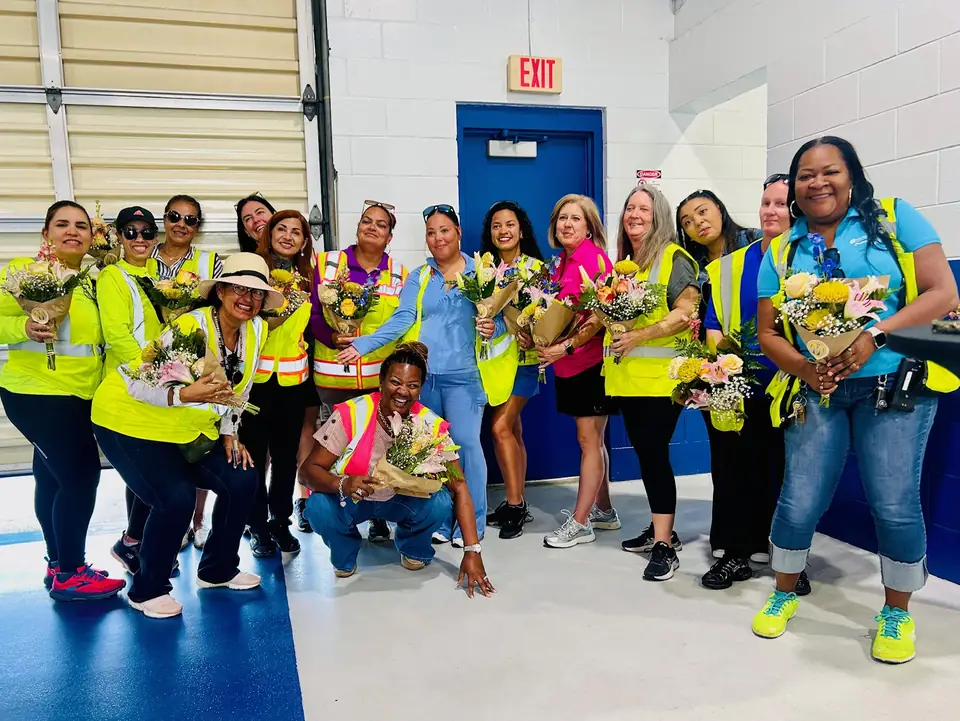
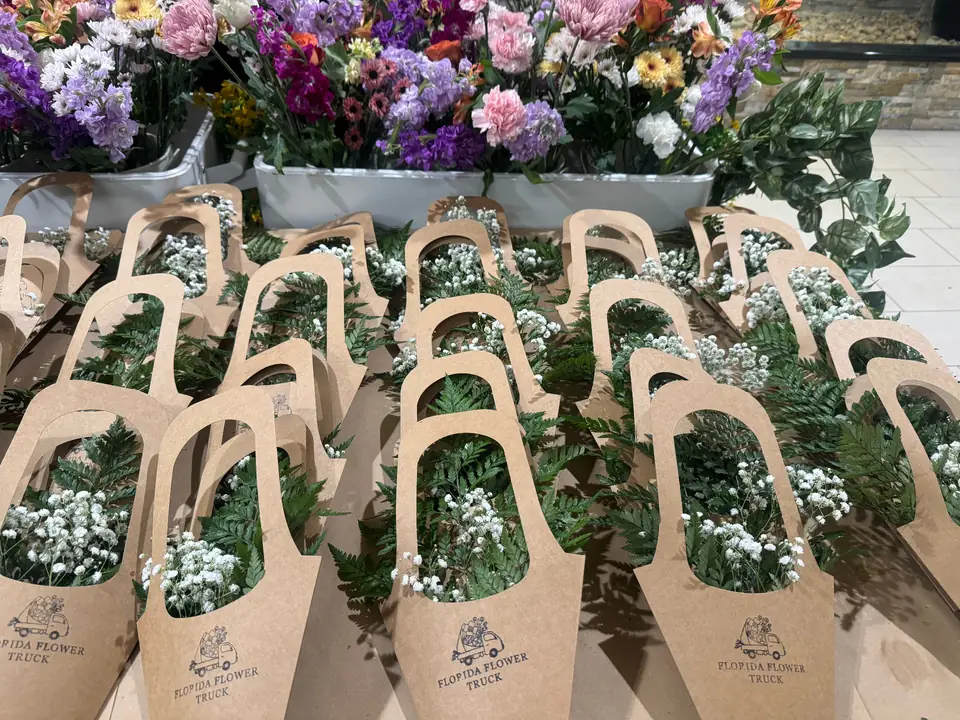
The flower truck started because my husband's daughter — I'll call her that because it's accurate, and "stepdaughter" doesn't capture what she is — was thinking about leaving teaching high school for a flower truck gig. Her path has since taken her elsewhere, and she's on to doing great things in many ways. But the truck stayed. It kept going. There's something special that happens when a person is holding flowers. Watch someone at a corporate event with a hand-tied bouquet in their hand. They get quiet for a second. Then they tell you something. "My wife loves flowers." Or "my husband always notices when there are flowers on the table." Or "I'm taking these to my boss — she does so much for all of us and she'd never ask, but I want her to have something." Nobody prompted any of that. The flowers prompted it. Because the flowers, unlike the slide deck behind them, are real. They smell like something. They weigh something. They have a moment in time attached to them — this moment, with these people — that can't be downloaded or copied or scaled. We run a flower truck because we think most workplaces need more of those moments and don't know how to make them. We help.
The argument against flowers (and why it's wrong)
People will tell you flowers aren't worth it because they don't last. I would argue: that's the point. Everything is temporary. The stress you're carrying today. The project you can't stop thinking about. The job. The version of your team that exists in this exact quarter, with these exact people, before someone leaves or gets promoted or moves to Charlotte. Even us — sitting at our desks, building our virtual cities, certain that what we're doing matters — we are also temporary. The flowers don't pretend otherwise. That's their honesty. What they say, when a person holds them, is: this moment is here, and it's worth your attention, and it will not be here for long, and that is exactly why it counts. I'm a reader. I've read a lot of leadership books. I have a couple of master's degrees and have spent time in both the entrepreneurial world and corporate America. I've worked in financial services, defense, utilities, and elective medicine. I've served in the military. I've been a co-founder and worked as a business consultant. The point is that I've spent some time studying teams — trying to figure out the secret sauce of what makes a high-performing one. And I will say this: your first team is your family. That's where I've learned the most.
What In Bloom is for
This is a publication about the quieter work of leadership. Belonging — the kind that doesn't need to be announced. Presence — the kind that doesn't require a slide deck. Quiet leadership, which we think drives transformation in a way the loud kind almost never does. Growing well, which is not the same as growing fast. We'll write about what we're noticing — at the truck, in the rooms we're in, in the rooms we used to be in. We'll write about what's working and what isn't. Some essays will be long and some will be short. We'll write when we have something to say. We won't write when we don't. If any of that sounds like the kind of thing you'd like to read, you're in the right place.
You belong right where you are. Let's grow from there.